
Is Transport Fever 3 Worth Buying? Launch Review and Community Verdict
Every time a new transport tycoon lands on my radar, I tell myself I’ll be cool about it. I’ll wait for reviews, wait for patches, wait for a sale. And every time, I end up lying awake at 2 a.m., wondering if my freight trains would finally stop deadlocking at that one cursed junction.
So when Urban Games confirmed that Transport Fever 3 is arriving on September 29, 2026, my “be cool” plan lasted about four minutes.
Now the launch is literally around the corner, and the question I keep getting from readers is the same: is it worth buying right now, or should you hold your wallet hostage until the first big patch? Let me be upfront about one thing. I’m writing this before release, based on the pre-launch information, early press impressions and the community chatter I’ve been soaking up for weeks. It’s not a post-launch verdict. What it is, is my honest read of where this game stands and who it’s for.
Why This Series Matters to Me
If you’ve never touched the franchise, here’s the pitch. Train Fever, Transport Fever and Transport Fever 2 sit in a strange, wonderful corner of gaming. They aren’t pure model-railway sandboxes, and they aren’t cold spreadsheet simulators either. They’re a hybrid: you lay tracks and roads, you move people and cargo, and you watch a tiny living world grow around your decisions.
That niche is small but fiercely loyal. And loyalty is exactly why this launch is such a big deal. The reported budget is north of $25 million, the highest in the series’ history. That’s not indie-hobby money anymore. That’s a studio being handed a real shot at the mainstream.
What’s Actually New
Let me skip the marketing gloss and tell you what genuinely excites me.
A Huge Roster, and Finally Some Urban Variety
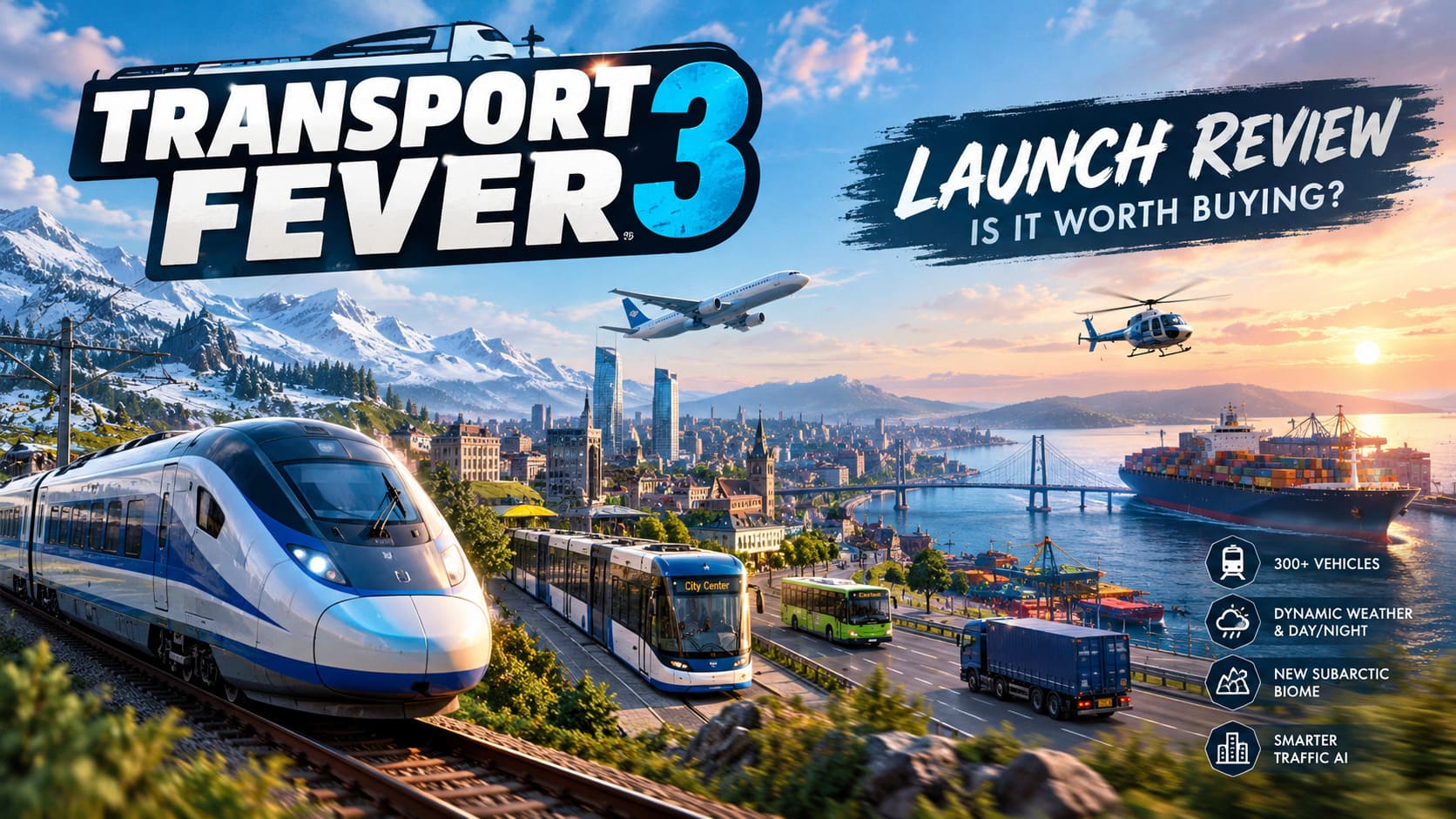
The game ships with over 300 historically accurate vehicles spanning more than a century of transport history. Numbers like that can be filler, but the real story is the type of transport being added:
- Light rail and light metro: dedicated urban transit at last
- Cargo trams: freight moving through the city itself
- Helicopters: joining jets and supertankers in the air and sea lineup
The previous games were brilliant at connecting cities but a bit lazy at moving people inside them. Light rail and metros change that. Any city builder fan knows the pain of choked main roads, and now there’s a proper tool to fix it. Cargo trams excite me most, because inner-city freight has always been an awkward puzzle, and this feels like a smart answer.
Weather, Day and Night, and a Soundscape That Sounds Alive
The game finally has a full day-and-night cycle with dynamic weather, which you can adjust through a simple menu. On its own that would just be eye candy. What makes it interesting is that it’s tied into a new dynamic audio system. Sounds shift with the biome, the weather and the hour.
I can’t overstate how much audio matters in a game where you spend hours staring at moving vehicles. A quiet valley at midnight should feel different from a rainy rush hour in a busy hub, and from what’s been described, it will.
A New Cold Biome
Alongside the temperate, tropical and dry climates, there’s a new subarctic region. Maps are procedurally generated, so terrain, water and resources reshuffle every time. Swamps, marshes and frozen hills mean your bridge and route planning can’t be lazy. As someone who has made every rookie mistake known to civil engineering, I’m looking forward to being humbled again.
The Part Where the AI Finally Grows Up
Here’s a detail that doesn’t get enough attention. Road traffic AI has been upgraded. Drivers can now overtake slower vehicles and reroute around bottlenecks instead of trundling in a rigid, mindless line.

That sounds small until you remember how much of your time in these games goes to fixing traffic. Smarter drivers mean your highway and bus lane designs actually get rewarded for being good. That’s the kind of quiet improvement that separates a sequel from a reskin.
The Economics: Still Hardcore, Still Rewarding
Don’t let the prettier visuals fool you. This is still a serious economic sim. The core rule hasn’t changed: every delivery earns money, and every vehicle costs money to run. Your whole game is balancing big infrastructure bets against daily operating costs.
Cities respond to how well you supply them with goods and how well you connect them to their neighbors. Feed a town properly and it grows. Neglect it and it stalls. You’ll be juggling:
- Bank loans and interest rates
- Citizen satisfaction
- Supply chain delivery speeds across different climate zones
This is where the game will either hook you or overwhelm you, and I’ll be honest about the flip side.
The One Complaint I Already Have
Early reviews, including those from Igromania, flagged a familiar irritation: many important interface icons have no text labels. The UI looks sleek, but new players may spend their first hours hovering over buttons just to read tooltips.
I’ve lived through this kind of thing before, and it’s survivable. But it’s a real friction point, and if you’re new to the genre, expect a learning curve that feels steeper than it should. It’s also exactly the kind of thing a good post-launch patch can soften.
The Elephant in the Room: Paradox Interactive
Now for the drama. This is the first entry in the series published by Paradox Interactive, replacing Good Shepherd Entertainment. On r/paradoxplaza and r/TransportFever, the reaction is sharply split, and I see both sides.
The optimistic case: Paradox is famous for supporting strategy and simulation games for years, sometimes decades. That means long-term updates, steady bug fixes and, crucially for this series, a healthy modding scene. Transport Fever lives and dies by community-made maps, vehicles and liveries. A publisher that respects that is a genuine win.
The pessimistic case: Paradox’s DLC reputation is, let’s say, legendary. Steam and Reddit threads are full of players fearing an endless drip of paid packs. The worry is that historical vehicle sets or important features could end up behind paywalls later.
My personal position? I’m cautiously hopeful, but I’m not naive. Urban Games keeps creative control, which matters. Still, I’d rather judge Paradox by what they do after launch than by what the internet fears they’ll do. That said, if a lot of DLC turns up early, I’ll be the first to complain about it loudly.
What the Community Is Saying
The mood on YouTube is warm. Well-known simulator creators such as Squirrel have been showing off late-game footage, and viewers love the visuals: long freight trains rolling through valleys at sunset, that kind of thing. People are especially happy about the light rail and city management additions, which bridge the gap between a transport tycoon and something like Cities: Skylines without losing the logistics focus.
Over on r/tycoon and r/TransportFever2, the general feeling is that this is a polished evolution rather than a risky reinvention. A few people mention that the marketing felt quiet before launch, but the pre-orders and the interest in the Collector’s Edition suggest the core fanbase is very much showing up.
Editions and Prices at a Glance
| Edition | Price (PC) | Price (Console) | What You Get |
|---|---|---|---|
| Standard | $49.99 | $59.99 | The base game |
| Deluxe | $64.99 | $74.99 | 11 legendary vehicles (including the Concorde and Trans-Europe Express), 2 architectural wonders (including the Eiffel Tower), 3 hand-crafted maps, bonus soundtracks |
| Collector’s | $119.99 | n/a | Digital Deluxe key, hero statue, 200-page hardcover art book, card game, music box, memorabilia (limited to 10,000 copies) |
PC versions are on Steam, Epic Games Store and GOG. Consoles are PlayStation 5 and Xbox Series X/S.
There’s also a nice touch for returning fans: a 10% Loyalty Discount if you own Transport Fever 2 on the same platform. It applies to the Standard and Deluxe editions, works during pre-order, and stays valid for 14 days after launch. That gives you a little breathing room to decide without losing the deal.
So, Who Should Buy It Right Now?
Let me make this practical.
Buy on day one if:
- You loved Transport Fever 2 and want more depth, more vehicles and more toys
- You enjoy multi-layered logistics and don’t mind tinkering
- You care about the modding scene and want to be there from the start
Wait a little if:
- You get overwhelmed by dense interfaces and lots of numbers
- You’re new to the genre and want the UI rough edges smoothed first
- You want to see Paradox’s DLC roadmap before committing
Because the loyalty discount lasts two weeks past launch, waiting a few days to read real player reports costs returning owners nothing.
My Bottom Line
I try not to hand out hype for free, so here’s my honest, measured position. On paper, Transport Fever 3 looks like the most ambitious game in the series: more vehicles, smarter traffic, living weather and sound, a tougher biome and genuinely useful urban transit. If even most of that lands as described, it’s a big step forward.
The risks are real but manageable. A cluttered icon-heavy interface is fixable. Paradox’s DLC habits are the bigger unknown, and only time will answer that one.
For me? I’ll be playing from the first day, my coffee will go cold, and I’ll probably ruin at least one city with a badly planned tram line. That’s the tycoon experience, and I’ve missed it.
I’ll share a proper post-launch verdict once I’ve had the chance to really dig into it. Until then, tell me: are you jumping in on September 29, or waiting for the dust to settle?


