Transport Fever 3 Release Date, System Requirements, and Gameplay Changes: The Ultimate Tycoon Guide
When Urban Games and Paradox Interactive started teasing Transport Fever 3, I did the classic gamer thing: “Cool, cool, I’ll believe it when I see it.” Sequels in the sim genre have burned me before. But after going through the dev updates, the trailers, and a truckload of Reddit and Steam threads, I’m officially hyped. Like, “already cleared my weekend” hyped.
Transport Fever 2 was a comfort game for a lot of us. You know the drill: 3 a.m., one more rail line, one more signal fix, and suddenly the sun is up and your cargo trains are finally running like a Swiss watch. TF3 is aiming to keep that magic and crank the depth up. The studio reportedly put a record-setting budget behind it (over $25 million, which is huge for a team this small), and you can feel that ambition in the feature list.
So grab a coffee, because this is a long one. I’ll cover the release date, the hardware you’ll need, the new mechanics, the editions, and my honest take on all of it.
Release Date and Platforms: One Day, Everywhere
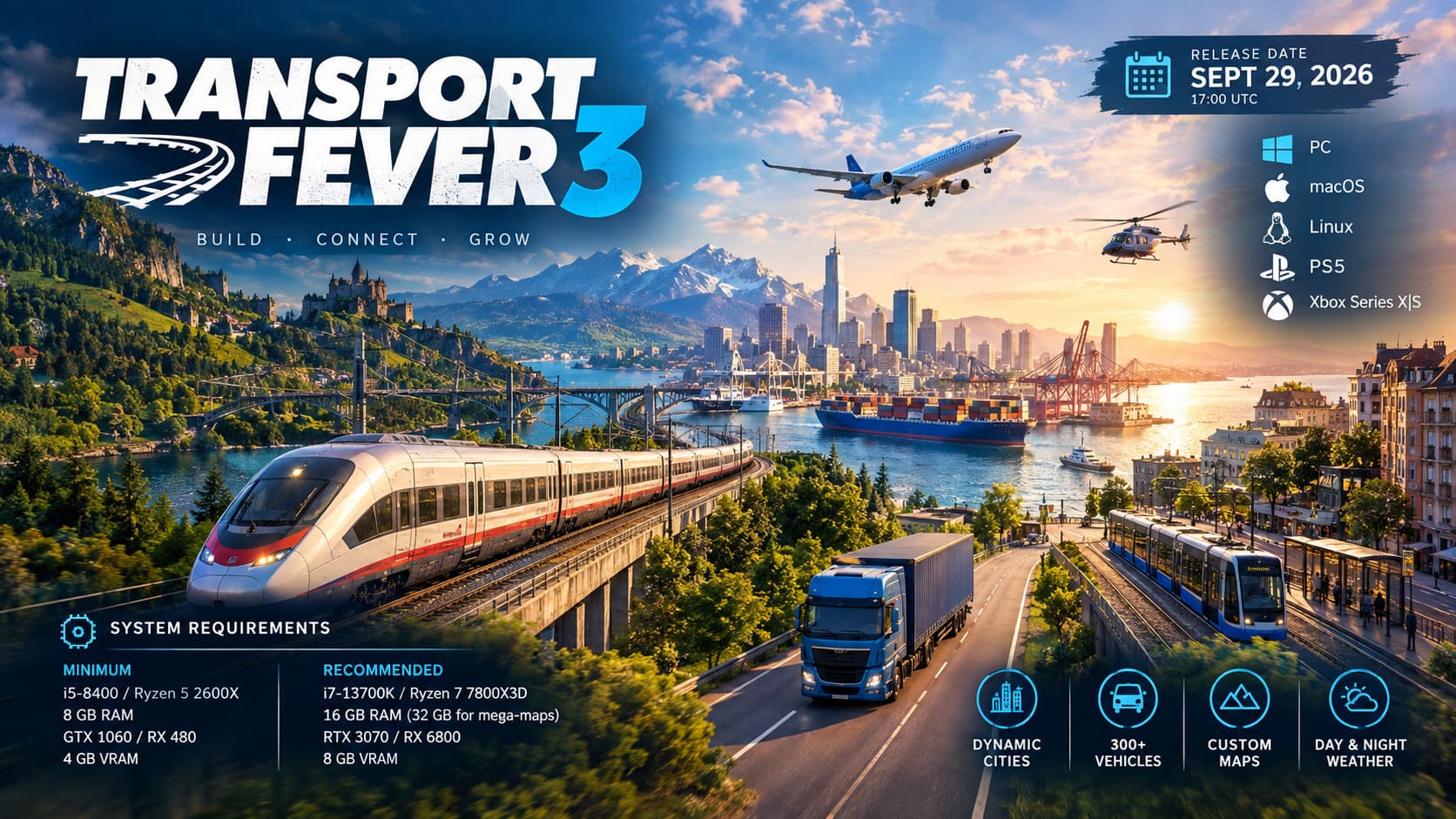
Mark your calendar: Transport Fever 3 launches globally on September 29, 2026, with digital unlocks at 17:00 UTC (console storefronts might shift that a bit depending on region).
The bigger news? This is a simultaneous multi-platform launch. No more “PC first, consoles in two years, maybe.” Day one, everybody plays:
- Windows PC via Steam, Epic Games Store, and GOG (with a proper offline installer, finally!)
- macOS
- Linux (optimized for Ubuntu 24.04 and newer)
- PlayStation 5
- Xbox Series X|S
As a PC guy, I love seeing Linux and GOG get real love. And honestly, console tycoon players have been waiting way too long to join the party.
There’s also a nice bonus for veterans: a 10% Loyalty Discount if you already own Transport Fever 2 on the same platform. It works on both the Standard and Deluxe editions and stays active for 14 days after launch. Free money, basically. Don’t sleep on it.
Can Your Rig Handle It? System Requirements Breakdown
Here’s the thing about management sims: they don’t melt your GPU, they murder your CPU. Every passenger, every truck, every cargo route is being calculated at the same time. Once your network grows into a monster, a weak processor will turn your dream empire into a slideshow.
Here are the official specs:

| Component | Minimum | Recommended |
|---|---|---|
| OS | Windows 10 (64-bit) / Windows 11 / Ubuntu 24.04 | Windows 11 / Ubuntu 24.04+ |
| CPU | Intel Core i5-8400 or AMD Ryzen 5 2600X | Intel Core i7-13700K or AMD Ryzen 7 7800X3D |
| RAM | 8 GB | 16 GB (32 GB for mega-maps) |
| GPU | GTX 1060 / RX 480 / Arc A380 | RTX 3070 / RTX 3060 Ti / RX 6800 / RX 6700 XT / Arc A770 |
| VRAM | 4 GB | 8 GB |
| API | Shader Model 6.0 | Shader Model 6.0 |
| Storage | 90 GB | 90 GB on an SSD |
My Take on the Specs
The minimum requirements are honestly friendly. If you’ve got a mid-range rig from a few years back, you’re getting in the door. But let’s be real: “can run it” and “can enjoy it” are two different things. Once your map fills up with traffic and sprawling cities, expect to tweak settings.
The 90 GB install size is chunky, and it tells me the assets are seriously detailed: high-res textures, lovingly modeled vintage vehicles, big environments. And please, put it on an SSD. Don’t make me say it twice.
The recommended CPUs (i7-13700K and the 7800X3D) are a big signal. That 7800X3D pick screams “this engine loves cache and multi-threading.” If you’re planning those gigantic, everything-connected maps, the CPU is your real bottleneck. Also, community veterans are pushing 32 GB of RAM for anyone who wants to run mods or generate massive custom maps. Given how mod-heavy this community is, I’d say that’s the sweet spot.
The Big Gameplay Changes (a.k.a. Why I’m Actually Excited)
The devs said they didn’t want to “reinvent the wheel,” and I respect that. Don’t fix what isn’t broken. But they clearly went after the parts of TF2 that felt a little passive. Here’s what stood out to me.
1. Town Level Up: Finally, Cities With Goals
In older games, towns grew kind of organically as long as you kept feeding them goods. It worked, but it was a bit “set it and forget it.”
Now towns have distinct levels. Meet all of a town’s evolving needs and it levels up, complete with a fireworks show over the city center. Yes, fireworks. Am I a grown adult who will absolutely feel proud watching digital fireworks over a town I supplied with bricks? Yes. Yes, I am.
Jokes aside, this is smart design. Money stops being the only goal. It becomes a tool for building regional prosperity, and your progression is tied directly to how well you develop the map. That’s a much more satisfying loop than just watching a bank balance go up.
2. New Transport Types: Helicopters, Cargo Trams, and Light Rail
The game packs 300+ realistic vehicles covering 125+ years of transport history, from 1900 all the way to 2025 and beyond. Planes, ships, trains, and trucks are all back with better fidelity, but the new toys are what got me:
- Helicopters: High-value cargo, VIP passengers, hopping over nasty mountain terrain. Chef’s kiss.
- Cargo Trams: Moving goods deep into dense cities without clogging streets with freight trucks. This is a very nice quality-of-life idea.
- Light Rail and Light Metro: The missing link between buses and heavy rail. Booming cities finally get proper mass transit.
I’ve wanted that middle-tier transit option for ages. It fills a real gap in how you’d naturally build a big city network.
3. Map Creation and Weather
The map generator got a full overhaul. You can enter or randomize a world seed, then use sliders to shape mountains, water, and climate borders, all with a preview before you commit. That means you can basically set your own difficulty through geography alone. Want a brutal mountain-locked nightmare? Go for it. Want a chill flatland vibe? Also fine.
You also get a full day/night cycle and dynamic weather, from sunshine to heavy rain. Now, the important part: weather is purely cosmetic. No delays, no accidents, no random chaos ruining your timetables.
I’ll admit, part of me wanted rain to wreck my schedules for the drama. But the other, more sensible part of me knows that people who obsess over perfect timetables (guilty) will love this. It looks pretty and doesn’t punish you. Fair enough.
4. Logistics and Hub Management
This is where the hardcore players will feel at home. Large transfer hubs and regional warehouses now have real running costs, and those fees stack up fast. That means:
- Time your pickups for the “last minute” to avoid paying storage overhead.
- Sync your timetables tightly.
- Build balanced hub-and-spoke delivery models, because the game calculates regional demand more precisely and rewards smart design.
Translation: lazy stockpiling is dead. Efficiency finally matters in a very tangible way, and I’m here for it.
Paradox, Small Team Energy, and the Curated Mods Program
Urban Games is a team of roughly 25 developers. That’s tiny for a project of this scale. Historically they handled QA in-house, which is heroic but exhausting. The Paradox Interactive partnership gave them access to serious testing infrastructure, so pathfinding bugs and optimization bottlenecks could be squashed before launch. Not after. Before. Revolutionary concept, I know.
The best part, according to the studio: Paradox stayed completely hands-off on creative design. So the game keeps its identity. That’s exactly what I wanted to hear.
Now, the mods. Modding is the heartbeat of the Transport Fever series. Custom maps, scripts, and hundreds of real-world train assets are why these games stay alive for years. TF3 launches with the Official Curated Mods Program, and here’s the twist: instead of selling paid mod packs, Urban Games is funding selected modders directly through grants. Those modders get early access to dev tools and direct communication with the studio.
The result? Free, developer-approved curated mods available on day one, integrated into the game’s look and mechanics. No paywalls, no shady microtransaction vibes. This is how you treat a community, honestly.
Editions and Pricing: Which One Should You Grab?
There are three versions, so let’s make this painless:
| Edition | PC Price | Console Price | What You Get |
|---|---|---|---|
| Standard | $49.99 | $59.99 | Full base game, campaign and sandbox modes |
| Deluxe | $64.99 | $74.99 | Standard + 11 legendary vehicles (Concorde, Trans-Europe Express), 2 architectural wonders (Eiffel Tower), 3 scenario maps, 4 exclusive wild animals, extra soundtrack |
| Collector’s | $119.99 (physical) | $119.99 (physical) | Deluxe digital key + hero statue, 200-page hardcover art book, card game, mechanical music box, keychain, stickers, poster |
Pre-order bonus: Everyone who pre-orders gets the Pre-Order Pack with the detailed TS Queen Mary ocean liner, the Great Pyramid of Giza as a buildable landmark, and the Asian Elephant for tropical regions. A pyramid in your rail network. Absolutely unhinged, and I love it.
The Collector’s Edition is limited to 10,000 physical copies worldwide and sold through the official merchandise store. If you’re a collector and a die-hard fan, that art book alone looks like a flex for your shelf.
So, Which One Is Worth It?
- Standard is perfect if you just want the game and plan to lean on the free curated mods.
- Deluxe is the sweet spot for me. Concorde and the Trans-Europe Express are just cool, and the extra scenario maps add real value.
- Collector’s is for the shelf-decorators and the completionists. No shame, I get it.
And remember: if you own TF2 on the same platform, that 10% loyalty discount applies to Standard and Deluxe for two weeks after launch.
Final Thoughts: Is Transport Fever 3 the Real Deal?
Look, I’m cautious by nature, and no game is perfect on paper. We haven’t seen how the town-level system feels over a 40-hour campaign, or whether the hub costs strike the right balance. But everything I’ve read points to a studio that understands its audience.
Here’s what sells me:
- A real progression hook with town levels and fireworks
- New transport types that fill genuine gameplay gaps
- A free, community-first modding approach
- Day-one launch on PC and consoles
- A small team that got serious backing without losing creative control
If you love logistics, trains, and that hypnotic feeling of watching a perfectly tuned network hum along, this could be your next 500-hour obsession. Check your specs, clear that 90 GB, and get ready to build.
See you on the tracks.