
Carry The Count PC Minimum Specs: Graphics Card Requirements and Optimization Guide
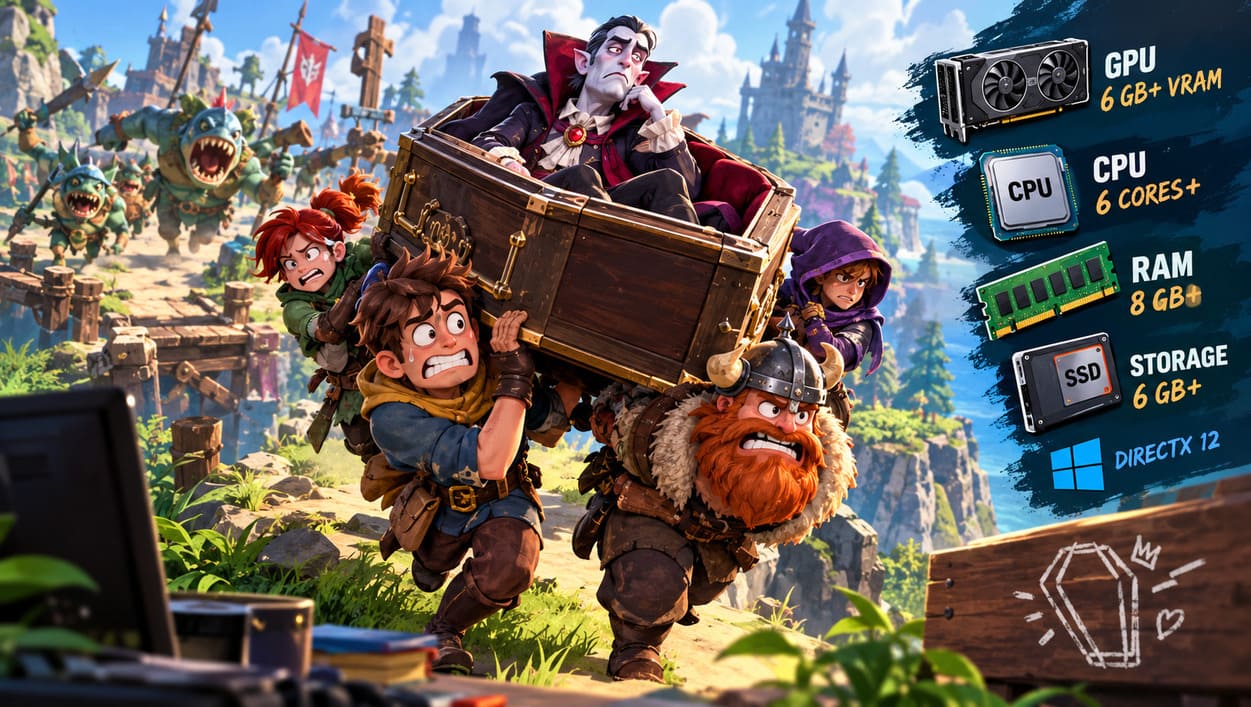
Picture this. Four friends, one absurdly heavy coffin, a grumpy vampire inside who expects first-class treatment, and a medieval fantasy world full of barbarians and angry fish people who want to ruin your evening. That’s Carry The Count, the 1-to-4 player co-op oddity from Little Bird Studios, published by Cathedral Studios. Your job is to drag the Count across a hostile map so he can reunite with his lover Romilda. Romance is alive, even if everyone carrying him is exhausted.
I love this premise. It’s dumb in the best way, and it’s exactly the sort of game that lives or dies on moment-to-moment feel. Here’s the catch: a game built on physics, teamwork and tight timing has zero patience for a choppy frame rate. One hitch at the wrong moment and the coffin slips, somebody gets flattened, and your voice chat turns into a courtroom drama. So before you buy, let’s make sure your PC won’t be the reason your squad wipes.
How to Fix Frame Drops During Barbarian Fights in Carry The Count
The Official Specs, No Fluff
Little Bird Studios lists a DirectX 12 requirement, which tells you right away that old hardware is on the chopping block. Here’s how the two tiers stack up:
| Component | Minimum | Recommended |
|---|---|---|
| OS | Windows 10 (64-bit) | Windows 11 (64-bit preferred) |
| CPU | Intel Core i5-8600K or AMD Ryzen 5 3600 | Intel Core i7-9700K or AMD Ryzen 5 3700X |
| RAM | 8 GB | 16 GB |
| GPU | GTX 1060 (6GB) or RX 5600 XT (6GB) | GTX 1080 (8GB) or RX 5700 (8GB) |
| DirectX | Version 12 | Version 12 |
| Network | Broadband connection | Broadband connection |
| Storage | 6 GB (SSD strongly recommended) | 8 GB (extra room for patches) |
| Audio | n/a | Sound card with mic jack for voice chat |
Notice how modest the file size is. Six gigabytes is tiny by today’s standards, so you won’t have to delete half your library to fit it. The recommended tier asks for a bit more breathing room, which is smart, because patches pile up.
Your Graphics Card Is the Main Character
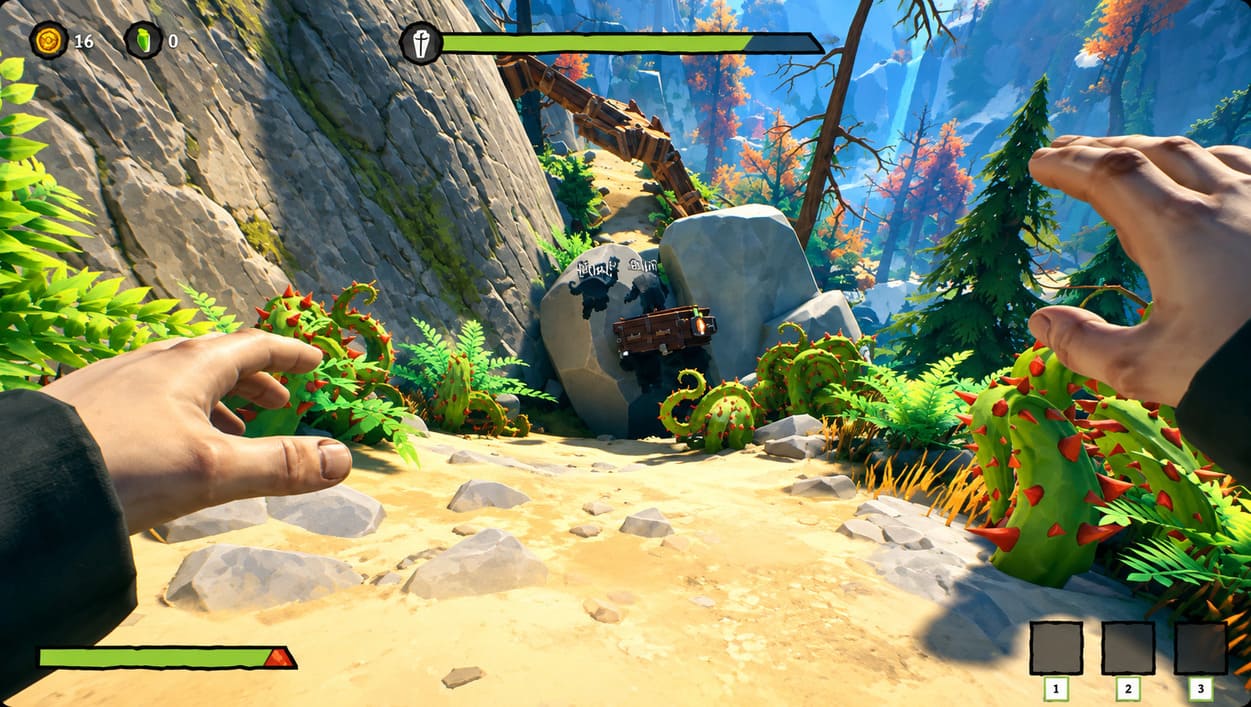
If I had to pick one part that decides how your run feels, it’s the GPU, no contest. Carry The Count throws stylized 3D worlds at you, packed with physics objects. You’re constantly picking up, tossing and balancing a giant box, and the game has to keep up with lighting, particles and effects while a barbarian mob is trying to turn you into a cautionary tale.
VRAM Is the Number That Matters
Both minimum GPUs carry 6 GB of VRAM, and that’s not an accident. Think of VRAM as the workbench your graphics card uses to hold textures and assets. Once the bench is full, the game spills overflow into system RAM, which is far slower. You feel it instantly as stutter, hitching and sudden frame drops. In a precision co-op game, that’s the kind of hiccup that ends runs.
So here’s my blunt take: skip 3 GB and 4 GB cards. They’ll struggle, and you’ll spend your whole session fighting the game instead of playing it.
The 6 GB minimum cards, the GTX 1060 6GB and the RX 5600 XT 6GB, have the memory bandwidth to handle 1080p at Low-to-Medium settings. That’s a perfectly respectable way to play a game like this. Nobody’s judging you.
If you want 1080p on High, or you’re chasing more than 60 FPS, step up to 8 GB. That’s where the GTX 1080 8GB and RX 5700 8GB come in. They chew through the heavy alpha effects, like water splashing around those evil fish creatures and the glowing trails of magic, without pushing you under the 60 FPS line that every co-op player should treat as sacred.
Old Legends vs. Modern Budget Cards
The official list leans on Pascal (GTX 10-series) and RDNA1 (RX 5000-series) cards. They’re reliable veterans, but let’s be honest, they’re showing their age. If you’re building or upgrading today, here’s how newer cards line up:
| Tier | Older Reference Card | Modern Equivalent to Consider |
|---|---|---|
| Minimum baseline | GTX 1060 6GB / RX 5600 XT 6GB | RTX 3050, RX 6600 |
| Recommended baseline | GTX 1080 8GB / RX 5700 8GB | RTX 4060, RX 7600 |
Cards like the RTX 3050, RTX 4060, RX 6600 and RX 7600 should comfortably beat the old GTX 1080 thanks to better architectural efficiency and stronger DirectX 12 driver support. If you’re shopping anyway, don’t buy a used relic just because it appears on a spec sheet. Newer budget silicon usually gives you more performance per dollar and a longer shelf life.
Modern cards also open the door to upscaling tech. Carry The Count has a distinctive art style, but spatial upscalers can claw back frames during the messiest moments, like a four-player boss fight where barbarian attacks fill the screen with particles. Even if you don’t need the extra frames all the time, having them in your pocket for chaotic scenes is a real perk.
Don’t Sleep on the CPU
Everyone obsesses over graphics cards, but this game has a physics-heavy co-op engine, and your processor has real work to do. Keeping four players in sync, tracking object positions and running enemy pathfinding all land on the CPU.
The minimum asks for an Intel Core i5-8600K or AMD Ryzen 5 3600. Both are popular six-core chips that handle multiplayer synchronization and entity positioning well. The recommended tier bumps you to an Intel Core i7-9700K or AMD Ryzen 5 3700X, which gives you headroom when all four players are interacting with the world at once.
Here’s the trap: a weak CPU creates a bottleneck. Your shiny GPU sits around bored while the processor is still working out where a falling trap should land or how a horde of enemies should path toward you. You can throw money at graphics and still get a mediocre experience if the CPU can’t keep up. Balance your build.
RAM: 8 GB Works, 16 GB Feels Better
Eight gigabytes is passable, but only if you behave. Close your browser tabs (yes, all forty of them), shut down recording software, and don’t leave a pile of launchers running. Sixteen gigabytes, ideally in dual-channel, is where the game stops fighting your operating system. It cuts down on mid-session crashes and gives Windows room to breathe during those marathon co-op nights.
Real-World Tuning: What Players Actually Do
Meeting the paper specs is only half the fight. Cooling, background processes and thermal throttling all change how the game runs on your machine. Community feedback from hardware forums, YouTube benchmark channels and Steam threads points to the same handful of fixes.
- Force the right GPU. This one hits laptop players constantly. Windows often defaults to the integrated graphics chip instead of your dedicated card. Open Windows Graphics Settings or the NVIDIA/AMD control panel and explicitly assign Carry The Count to the high-performance GPU. It takes thirty seconds and can be the difference between a slideshow and a smooth run.
- Respect your VRAM. On a 6 GB card, don’t crank textures to Ultra just because the slider exists. Keep textures at Medium or High and pull back heavy ambient occlusion and shadows. Saturating VRAM is the number one cause of those sudden, inexplicable stutters.
- Install it on an SSD. Don’t put this on an old mechanical hard drive. Asset streaming in modern co-op games depends on fast reads, and an SSD wipes out the micro-stutters you’d otherwise get when moving between different biomes.
Beyond those three, there’s a network angle people forget. The game lists a broadband connection, and that matters more than usual here. In a four-player physics game, lag doesn’t just look bad, it desyncs the coffin and gets somebody blamed. A stable wired connection beats fancy hardware if your Wi-Fi is flaky.
So, What Should You Actually Buy or Upgrade?
Let me cut through the noise with some direct advice:
- Already own a GTX 1060 6GB or RX 5600 XT? You’re fine. Play at 1080p on Low-to-Medium, watch your VRAM, and you’ll get a solid experience.
- Sitting on a GTX 1080 or RX 5700? You’re in the recommended zone. Go High at 1080p and enjoy it.
- Building fresh? Grab an RTX 4060 or RX 7600 class card, pair it with a modern six-core CPU and 16 GB of RAM. You’ll have room to spare and upscaling as a safety net.
- On a 4 GB card or a 4-core processor from the stone age? Upgrade before launch night. You’ll thank yourself when the coffin is hanging over a ledge and your frames hold steady.
The game itself is cheap on storage, forgiving on the low end, and sensible about what it asks for. Nothing in these specs screams ‘you need a monster rig,’ which is great news for a co-op title, because the whole point is getting your whole friend group in the lobby, not just the one guy with the expensive PC.
Final Thoughts
Carry The Count is exactly the type of weird, chaotic, friendship-testing game that makes co-op magical. Its hardware demands are reasonable, but the margin for error in gameplay is razor thin, so a smooth frame rate isn’t a luxury, it’s part of the mechanics. Secure a GPU with at least 6 GB of VRAM, back it with a proper six-core CPU, run the game from an SSD, update your drivers, and lock in your network.
Then grab three friends who can be trusted, or at least three friends who’ll be funny when they fail, and go deliver that grumpy vampire to his beloved Romilda. Just watch the ledges. The coffin doesn’t forgive.


